
Last updated November 2, 2026
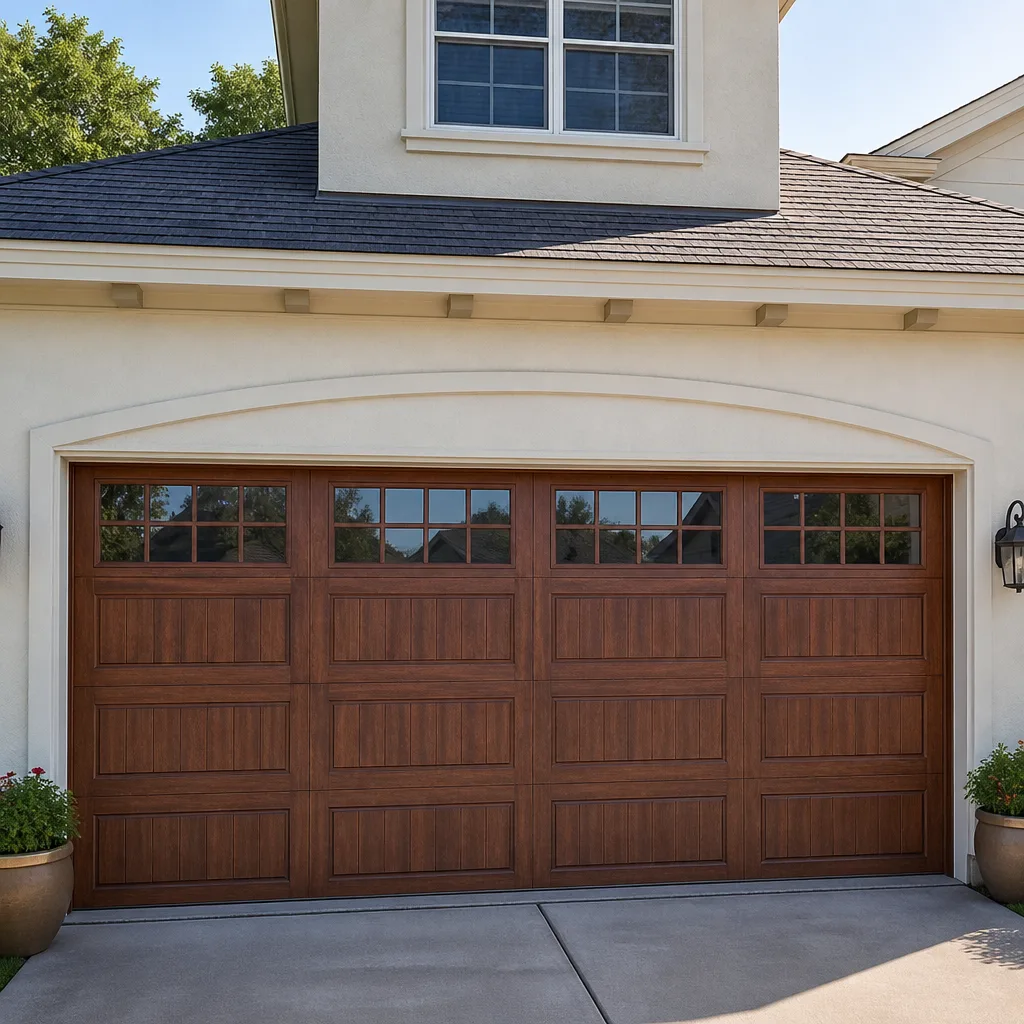
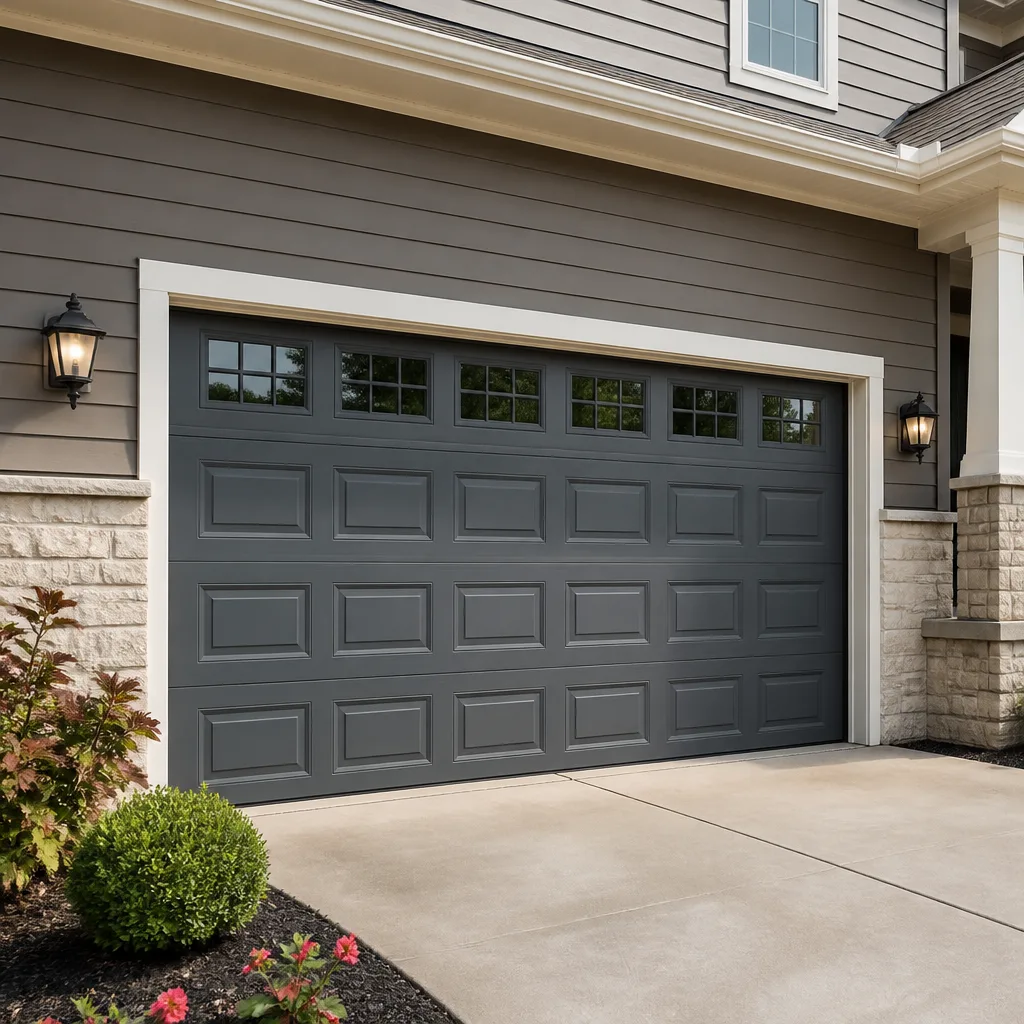 Raised-panel steel
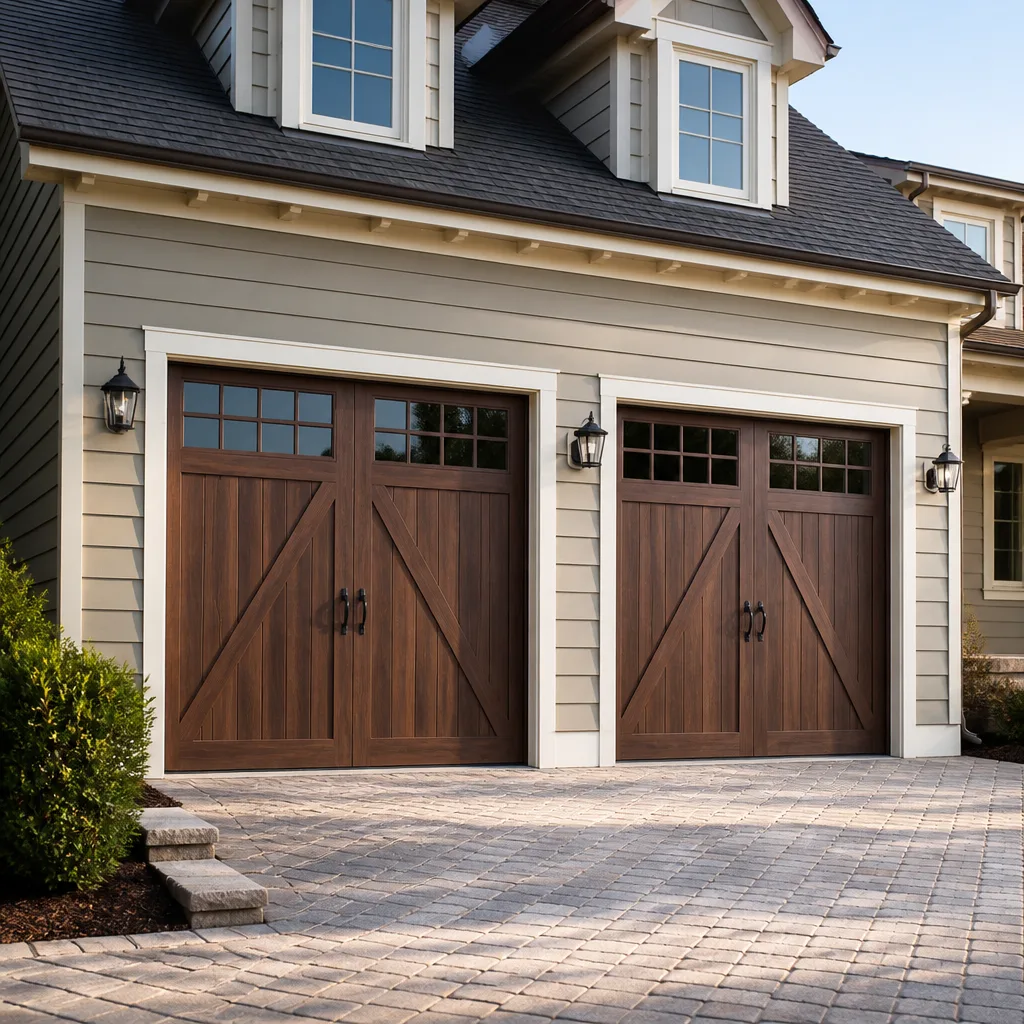 Carriage house
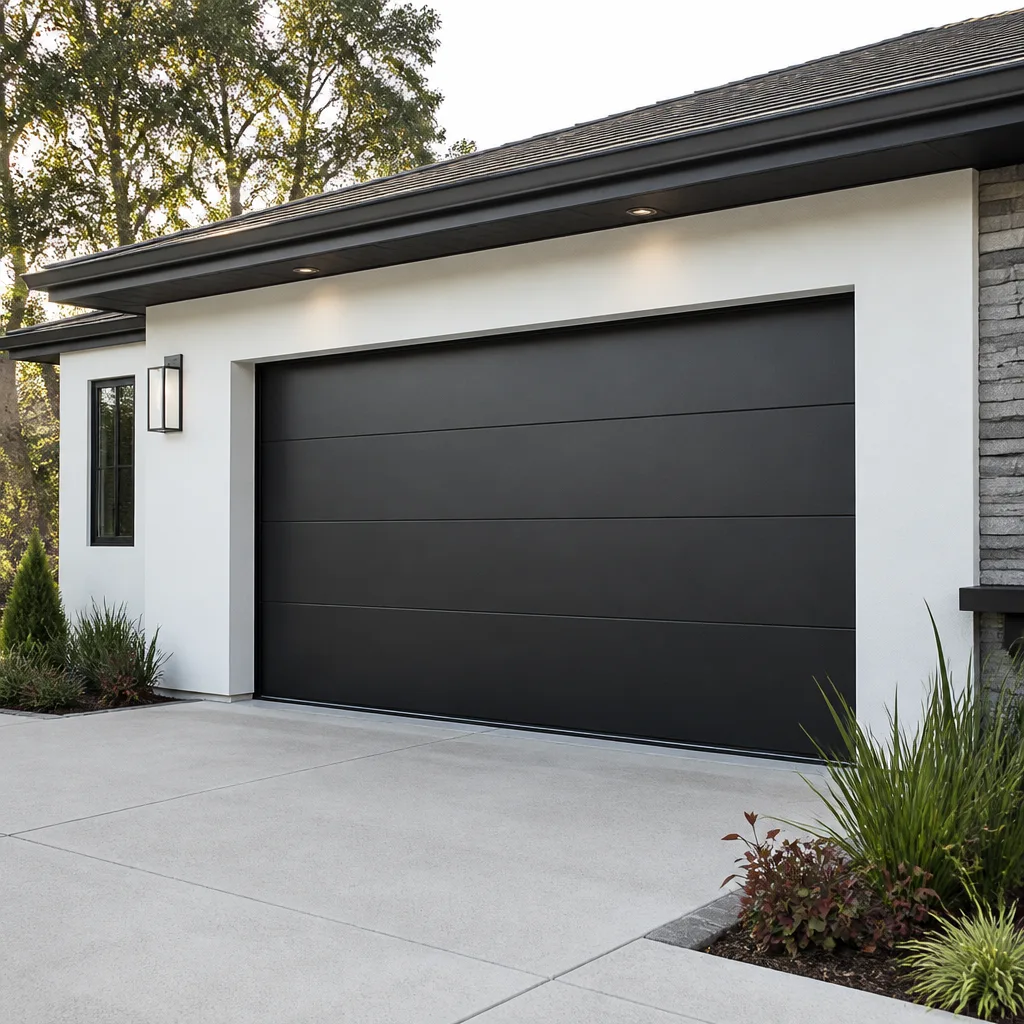 Modern flush
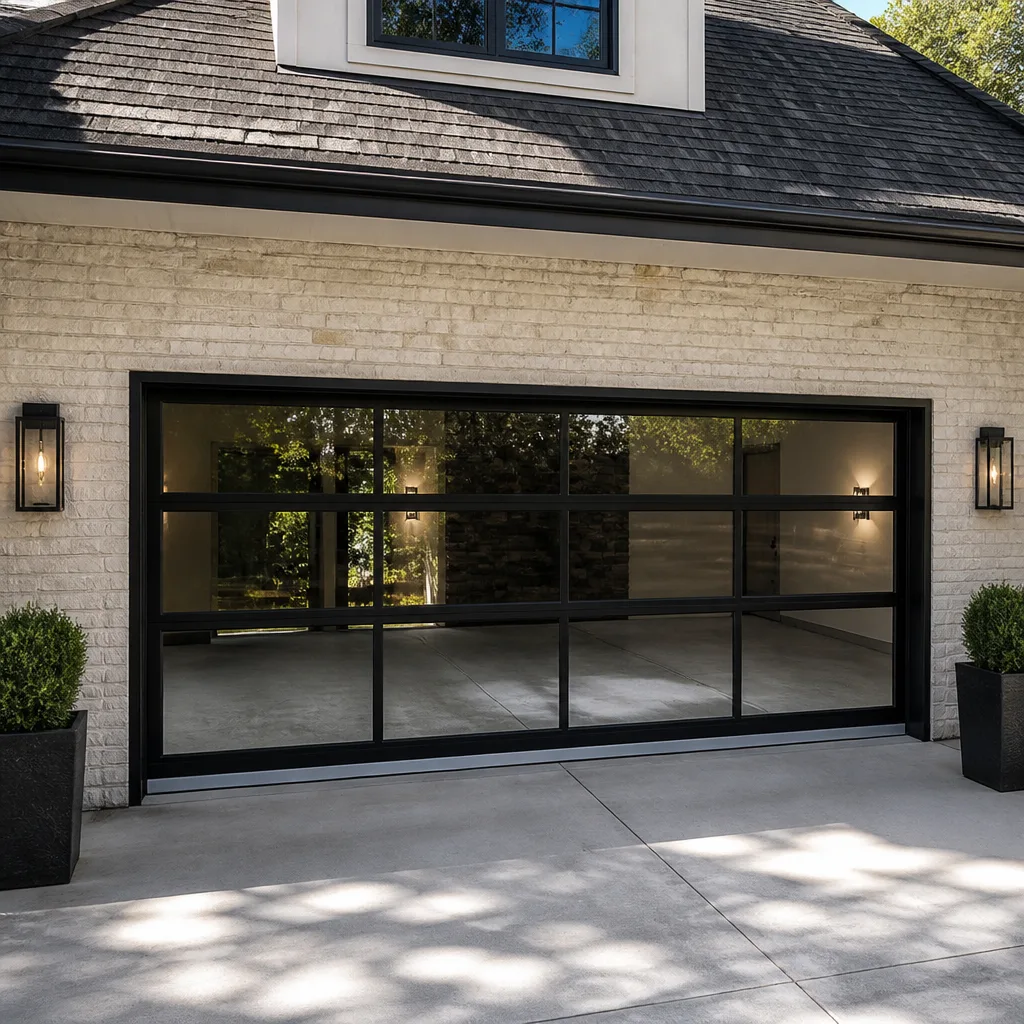 Full-view glass
 LiftMaster openers
 Chamberlain openers
Full 25-point door and opener safety check with every visit - springs, cables, rollers, tracks, and your LiftMaster or Chamberlain opener included
You get a price before we start. It does not change when the truck arrives.
Get your free estimateDIY vs Professional Garage Door: The Menifee Homeowner’s Decision Guide
Here’s a fact most homeowners don’t discover until it’s too late: a garage door torsion spring under tension stores roughly the same mechanical energy as a small firearm cartridge. When that spring snaps during a DIY repair, it releases all of that energy in about a tenth of a second. In Menifee, where the summer heat cycles put extra stress on metal components, we’ve seen springs fail at higher rates than coastal communities 40 miles west. This guide will show you exactly which garage door tasks you can safely handle, which ones you should never touch, and how to make that call without guessing.
Quick Answer
DIY is appropriate for garage door maintenance and cosmetic work: lubricating rollers, replacing weatherstripping, programming remote controls, and painting the door. Professional service is non-negotiable for torsion spring replacement, cable work, track realignment, and opener repair involving electrical or structural components. The dividing line isn’t your skill level; it’s whether a failure while you’re working has a predictable, serious injury outcome, and whether you have the specific tools required. In Menifee, professional spring replacement typically costs $180 to $340, while a failed DIY attempt often results in an emergency room visit, a damaged door panel, and a rush service call that triples the original cost.
Styles & brands we work with
- Raised-panel steel
- Carriage house
- Modern flush
- Full-view glass
- LiftMaster openers
- Chamberlain openers
Table of Contents
- The Real Cost of a Failed DIY Repair
- Tasks That Are Genuinely Safe for a Careful DIYer
- Tasks You Should Never Attempt Without Training
- Why Torsion Springs Are the Line You Don’t Cross
- California Liability and Insurance: What Homeowners Need to Know
- Menifee Climate and How It Affects Your Decision
- The Highest-ROI DIY Task: The Monthly Balance Test
- Brand Compatibility and Why It Changes the Calculation
The Real Cost of a Failed DIY Repair
Let’s put numbers on the decision that most guides leave vague. When a Menifee homeowner attempts a torsion spring replacement and gets it wrong, the failure sequence is predictable. First, the winding bar slips out of the spring cone and becomes a projectile. That bar, typically 18 inches of half-inch steel, travels fast enough to break bone or embed itself in drywall. The homeowner goes to urgent care or the ER. The door, now completely unbalanced, slams down or hangs unevenly, bending a panel or pulling a track off its mounting. The homeowner then calls for emergency professional service.
Here’s what that sequence costs:
- Emergency room or urgent care visit: $200 to $3,000 depending on insurance and injury severity. A hand laceration from a snapped cable can require surgery.
- Door panel damage: $250 to $600 to replace a single bent steel panel, more if the door is a wood composite or custom style from Clopay or Amarr.
- Track or bracket repair: $150 to $400 for realignment and reinforcement.
- Rush professional spring replacement: $300 to $450 when we’re called after a failed attempt, versus $180 to $340 for a standard scheduled replacement.
- Total failed DIY cost: $900 to $4,450 plus injury recovery time.
Compare that to calling us first, where the spring replacement is quoted and agreed before any work begins. The math doesn’t need help making its point. What surprises many Menifee homeowners is that the professional quote includes the spring, the labor, the balance check, and the safety inspection. A DIY parts purchase from an online supplier runs $60 to $120 for a pair of springs, which sounds cheaper on the surface. But it buys none of the assessment. A professional isn’t just swapping a spring; they’re checking why it broke, whether the other spring is near failure, whether the cables are fraying, and whether the opener is working harder than it should. A spring that breaks once often signals a door that has drifted out of balance over months.
Our Garage Door Repair in Menifee page covers what a full professional repair visit includes, for anyone who wants to see the standard scope of work before calling.
Tasks That Are Genuinely Safe for a Careful DIYer
We’re not going to tell you that every garage door task requires a professional. That would be dishonest, and it would also be bad advice. There are several maintenance jobs that a homeowner with basic tools and reasonable caution can handle safely. The common thread among these tasks is simple: none of them involve releasing or working against high-tension springs, cables, or the door’s weight-bearing mechanism.
Here are the tasks we’d actually recommend a Menifee homeowner consider doing themselves:
- Roller lubrication: Apply a silicone-based lubricant to the rollers, hinges, and bearing plates every six to twelve months. This takes 15 minutes and keeps metal components from grinding in Menifee’s dry, dusty air. Use spray lithium grease on the hinges and a lighter silicone spray on the nylon rollers. Do not use WD-40; it’s a solvent, not a long-term lubricant, and it leaves metal components drier than before.
- Weatherstripping replacement: The rubber seal along the bottom of the door cracks and hardens in the Menifee sun within two to three years. Replacement costs $15 to $40 for materials, takes under an hour, and requires no tools beyond a utility knife and a screwdriver. Slide the old seal out of the aluminum retainer, cut the new seal to length, and slide it back in.
- Remote control programming: If you buy a new remote for a Genie, LiftMaster, Chamberlain, or Craftsman opener, programming it usually takes 30 to 60 seconds. The instructions are printed on the opener’s motor housing or available online by model number. This is a no-risk task that saves a service call.
- Keypad battery replacement: Wireless keypads run on 9-volt batteries that last one to two years. If the keypad lights up but doesn’t open the door, change the battery before calling anyone.
- Photo-eye sensor cleaning: The sensors at the bottom of the door tracks get dusty in Menifee’s dry season. Wipe both lenses with a dry cloth. If the door still won’t close, check the alignment; a misaligned sensor is visible as a blinking light on one or both units.
- Painting the door: A steel door can be repainted with proper surface prep. Sand lightly, clean with a degreaser, apply a bonding primer, then a quality exterior latex paint. This is cosmetic, not structural, and a misstep costs a can of paint, not a hand.
The monthly balance test, which we’ll cover in depth later in this guide, also belongs on this list. It’s the single most valuable DIY habit a homeowner can build, and it requires no tools at all.
Tasks You Should Never Attempt Without Training
Now the other side of the line. These tasks share two qualities: they interact with high-tension mechanical energy, and a failure during the work causes injury, not inconvenience. They’re binary. There’s no version of “careful enough” that makes them safe without the proper tools and training.
Torsion Spring Replacement
This is the big one. Torsion springs are mounted above the door on a steel shaft, and they’re wound using two winding bars inserted into the spring cone. Each quarter-turn loads more tension into the spring until it’s wound tight enough to counterbalance the door’s weight, typically 7 to 8 full turns for a standard residential door. A fully wound torsion spring holds somewhere between 70 and 120 pounds of torque, depending on the door weight. If a winding bar slips, or if the spring cone fails, that bar becomes a projectile moving at high velocity. Lacerations, fractures, and finger amputations are the documented outcomes, not hypothetical worst cases. The OSHA guidelines for garage door work treat torsion spring handling as a professional-only task, and for good reason. We won’t walk you through the procedure here because describing it step by step in text is exactly how bad ideas become bad attempts. Hire this one out, always.
Lift Cable Replacement
The lift cables run vertically along both sides of the door and attach to the bottom brackets. They’re under full door tension at all times. When a cable frays or snaps, the door drops unevenly, and the remaining cable often whips sideways with enough force to cause serious cuts. Replacing cables requires releasing the spring tension first, which means you’re back to the torsion spring problem. It’s the same hard no.
Track Realignment or Repair
The horizontal and vertical tracks guide the door’s rollers through thousands of open-close cycles. They’re attached to the wall with lag bolts, and they need to be dead level and parallel within a quarter inch. If a track is bent from a vehicle impact, the door can bind mid-cycle and jump the track entirely, falling with full weight force. Realigning tracks requires disconnecting the opener, releasing tension, and resetting the entire system. A professional uses a level, specific torque settings, and a set of measurements that aren’t improvised.
Header Bracket Work
The header bracket anchors the torsion tube above the door opening. It’s under continuous load from the spring assembly. If the bracket loosens or pulls away from the wood, the entire spring system can shift, and replacing it safely means releasing all spring tension first. This is structural work with serious consequences if done wrong.
Opener Motor or Gear Replacement
Inside the opener’s housing, the drive gear and sprocket assembly transfer motor power to the chain or belt. Replacing those parts means opening the motor unit, pressing the gear onto the shaft with the correct amount of force, and reassembling it with proper tension. Get the chain tension wrong and the door jerks, binds, or runs off the sprocket. This is a job for our Garage Door Opener Repair in Menifee team, who work on these systems every day across LiftMaster, Chamberlain, Genie, and Craftsman equipment.
Why Torsion Springs Are the Line You Don’t Cross
The opening hook of this guide referenced a statistic worth expanding: torsion springs store enough mechanical energy to cause a permanent hand injury in a fraction of a second. That’s not an exaggeration from a safety manual. It’s a direct description of the physics. A residential torsion spring wound to counterbalance a 160-pound door carries roughly 40 to 60 foot-pounds of energy per spring. When that energy releases, it moves through the winding cone and the winding bars at speeds exceeding 90 miles per hour at the tip.
What makes this particular danger worse is the false sense of familiarity. A homeowner who changes their own light fixtures, hangs shelves, repairs a toilet, and wires a ceiling fan has built real competency around the house. Those tasks all reward carefulness. Torsion springs don’t. The risk profile is categorically different. Electrical work can be done safely with the circuit breaker off, with the right tools, with patience. Plumbing work can be test-fit and re-done. A torsion spring failure during installation can’t be walked back. It’s a one-attempt task with severe consequences for a failed attempt.
Menifee-area service records show torsion spring failure as the single most common garage door issue, which means most homeowners will face this decision at least once in the life of their home. If you live in the Menifee area and your spring has snapped, the door won’t open safely and you can’t be expected to know that from reading an article. Call a professional. Our Garage Door Repair in Menifee service handles this routinely, with the proper winding bars, the correct spring weight and cycle rating, and a full balance check after installation.
California Liability and Insurance: What Homeowners Need to Know
Here’s a point that almost no guide covers, and it matters for every Menifee homeowner: if you install a garage door component yourself, and that component later fails and injures someone, the liability picture changes. A professional installation from a licensed service includes a paper trail: the spring’s cycle rating, the installation date, the torque settings, the balance verification. That documentation becomes evidence of reasonable care if an incident leads to a claim.
A self-installed component carries none of that. If a spring you installed fails and injures a family member, a neighbor, or a future homeowner, your insurance company will investigate the installation. They’ll ask who installed the spring, when, and with what level of training. A homeowner installation is not automatically excluded from coverage, but it opens a line of questioning that a professional invoice closes. California is a comparative negligence state, meaning liability can be apportioned. A DIY spring replacement can shift a percentage of fault toward the homeowner, and that percentage becomes real money in a settlement.
This is not legal advice, and we’re not lawyers. But the pattern is consistent enough that we’ve heard it from Menifee homeowners who’ve been through the process. The professional invoice is a shield. The absence of one is a vulnerability. When the difference in cost between a DIY spring and a professional replacement is $150 to $200, the liability exposure isn’t worth the savings.
Menifee Climate and How It Affects Your Decision
Menifee’s climate shapes garage door behavior in ways that a generic DIY guide won’t mention. Three local factors matter:
- Summer heat and metal fatigue: Menifee regularly sees summer days above 100 degrees. Metal expands in that heat, and the spring’s steel coils expand and contract daily through the hot months. Over years, this thermal cycling weakens the metal’s fatigue resistance. Springs in Menifee don’t fail at the national average of 10,000 cycles; they often fail closer to 7,000 to 8,000 cycles, especially on doors that face south or west and absorb afternoon heat directly.
- Dry, dusty air: The IE’s dry air pulls moisture out of rubber and nylon components faster than coastal air. Weatherstripping hardens and cracks in two to three years. Nylon rollers degrade faster. The lubrication you apply also collects dust, which turns into a fine grit that accelerates wear. More frequent maintenance, not less, is the Menifee homeowner’s reality.
- Santa Ana winds: During Santa Ana events, wind gusts can push against a closed door with enough force to stress the cables and tracks. A door that’s slightly unbalanced is more vulnerable to wind-induced damage. If your door shudders or rattles during high wind, it’s telling you something about its balance.
These local conditions change the calculus on some DIY tasks. Lubricating your rollers twice a year instead of once is a reasonable Menifee adjustment. Checking your balance monthly instead of quarterly is also worth it. And for professional repairs, working with a team that understands the local conditions means springs are matched to their actual cycle count in this climate, not the national marketing spec.
The Highest-ROI DIY Task: The Monthly Balance Test
The one DIY task most homeowners skip is also the one with the highest return: the monthly balance test. This takes three minutes, requires zero tools, and catches problems early enough to turn a $250 professional repair into a $25 maintenance adjustment.
Here’s the step-by-step process:
- Close the garage door completely.
- Pull the emergency release cord. This is the red cord hanging from the opener rail. Pull it straight down until you hear a click, which disconnects the door from the opener.
- Manually lift the door by its handle. A properly balanced door should lift smoothly with one hand, with no more effort than lifting a full grocery bag. It should stay in place at waist height, not drift up or fall down.
- If the door is difficult to lift, or if it falls when you let go at waist height, the springs are no longer counterbalancing correctly. This means the opener is working harder than it should, which shortens its lifespan and strains the gears.
- If the door refuses to stay in place or the springs look rusty or stretched, note it and schedule a professional spring assessment.
- To reconnect the door, pull the emergency cord toward the door, then press the wall button or remote. The opener will re-engage automatically on the next cycle.
Run this test on the first Saturday of every month. In Menifee’s summer heat, when metal components are under the most stress, the test matters even more. A door that passes the balance test every month can go years between professional visits. A door that’s tested sporadically is the one that surprises its owner with a snapped spring at 7 a.m. on a workday.
Brand Compatibility and Why It Changes the Calculation
Here’s a factor that most DIY guides ignore entirely: your specific door brand and model changes what you can safely tackle. A Clopay steel door from 2015 and an Amarr heritage wood-look door from 2020 have different hardware, different spring packages, and different failure modes. A Genie opener from 2018 and a Chamberlain smart opener from 2023 have different control logic, different safety sensor behavior, and different diagnostic codes.
Where brand compatibility matters for decision-making:
- Spring sourcing: A torsion spring must match the door’s exact weight, height, and drum type. The color coding on springs isn’t universal across brands. A Wayne Dalton door, for example, uses a unique spring setup on many models. A generic spring purchased from an online retailer may technically fit but deliver the wrong torque, which puts extra load on the opener or causes the door to drift.
- Opener diagnostics: A Chamberlain opener flashes diagnostic codes that correspond to specific failure points. A LiftMaster unit does the same with a different code map. A Genie system has its own logic. Without brand-specific knowledge, a DIYer with a multimeter and YouTube can easily misdiagnose a logic board issue as a motor failure, or vice versa.
- Replacement parts fitment: Rollers, hinges, and brackets aren’t universally interchangeable. A hinge from a Clopay door doesn’t match an Amarr rail profile perfectly. A “universal” bracket often means “fits nothing well.” A slight mismatch leaves the door running with excess play, which accelerates wear on every other component.
This is why we talk about brand coverage as a trust signal. A team that works on Garage Door Installation in Menifee across Clopay, Amarr, Wayne Dalton, and Raynor products knows the nuance. When we assess a door for repair, the recommendation is based on what’s actually installed in your garage, not on what we happen to stock. A brand-agnostic assessment means we can tell you honestly when a repair makes more sense than a replacement, and execute either option.
For the DIY-minded homeowner, brand compatibility should influence which jobs you feel confident about. Painting a door is brand-neutral. Lubricating rollers is fine regardless of manufacturer. But anything involving spring torque, cable tension, or opener logic boards is where the brand-specific knowledge starts to matter, and the margin for error disappears.
Common Mistakes to Avoid
- Using WD-40 on rollers and hinges: WD-40 is a solvent and water displacer, not a lubricant. It strips away the existing lubricant and leaves metal components dry. In Menifee’s dusty climate, the result is fast-wearing joints and squeaky rollers within weeks.
- Buying springs online without matching the door’s actual weight: Torsion springs are not one-size-fits-all. A homeowner who orders a spring based on “standard 7-foot door” and doesn’t know their door’s exact weight will install a spring with the wrong torque, putting the door out of balance immediately. That wrong-balance door then works the opener to death.
- Ignoring the other spring when one breaks: Garage doors are typically fitted with two springs, and both were installed at the same time with the same cycle rating. If one breaks, the other is at the end of its life too. A homeowner who replaces only the broken spring saves $60 today and pays for a second service call within six months.
- Forcing a door that won’t move: When a door is stuck, the temptation is to push harder. That’s how tracks bend, panels dent, and cables snap. If your door binds or stops mid-cycle, stop and assess before applying force. The imbalance that caused the binding gets worse, not better, under strain.
- Adjusting opener force settings to “fix” a slow door: A door that’s running slow usually means the springs are weak or the rollers need lubrication. Cranking up the opener’s force setting to compensate doesn’t fix the underlying problem; it masks it until the opener’s gear or logic board fails. The force setting is a safety feature, not a tuning knob.
- Trying to repair a cable by splicing it: A frayed lift cable cannot be safely spliced. The splice creates a weak point that can fail catastrophically under tension. A frayed cable requires a full replacement, and that replacement requires releasing spring tension first. There’s no DIY version of that job.
- Forgetting that the garage door is the largest moving object in the home: A standard 16-by-7-foot steel door weighs 150 to 250 pounds. When it’s out of balance, it’s a guillotine with a motor attached. The mindset that treats a garage door like any other household repair is the same mindset that leads to emergency rooms.
See the difference
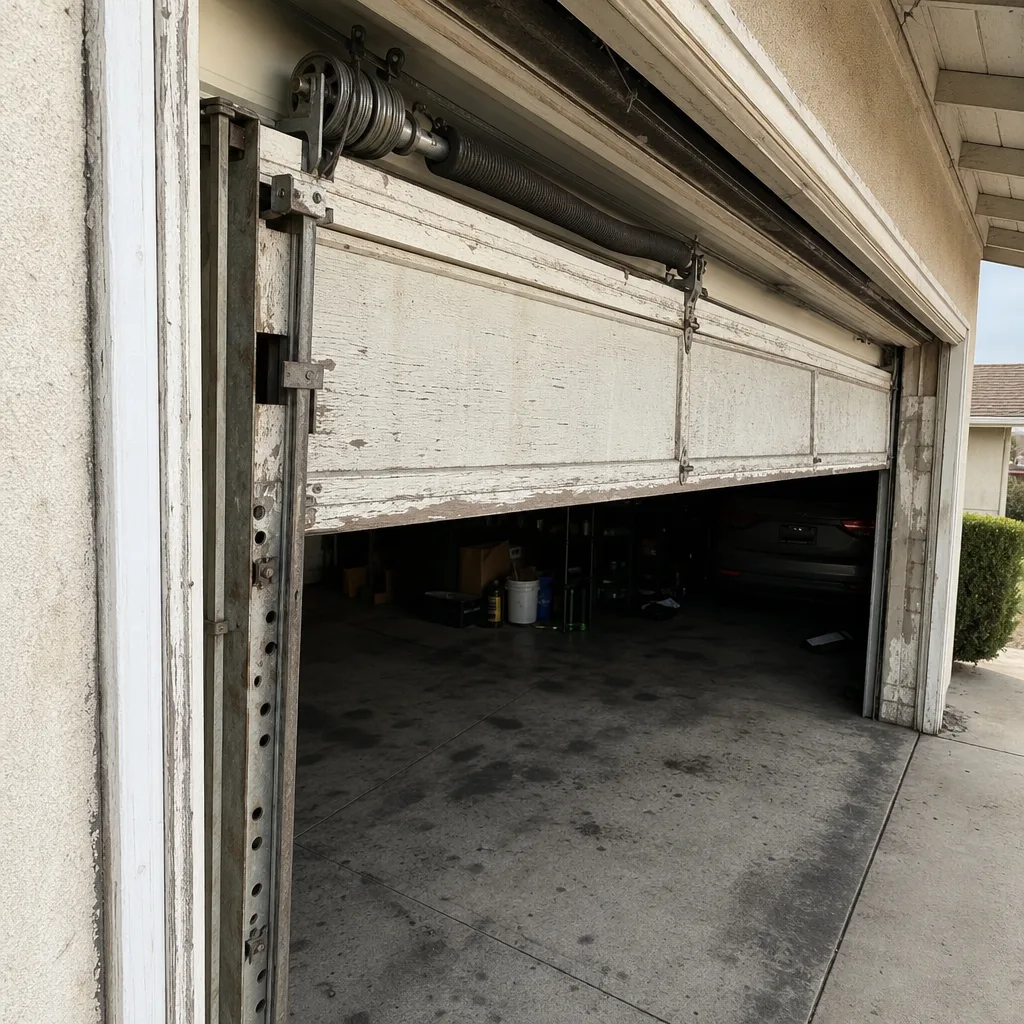 Before
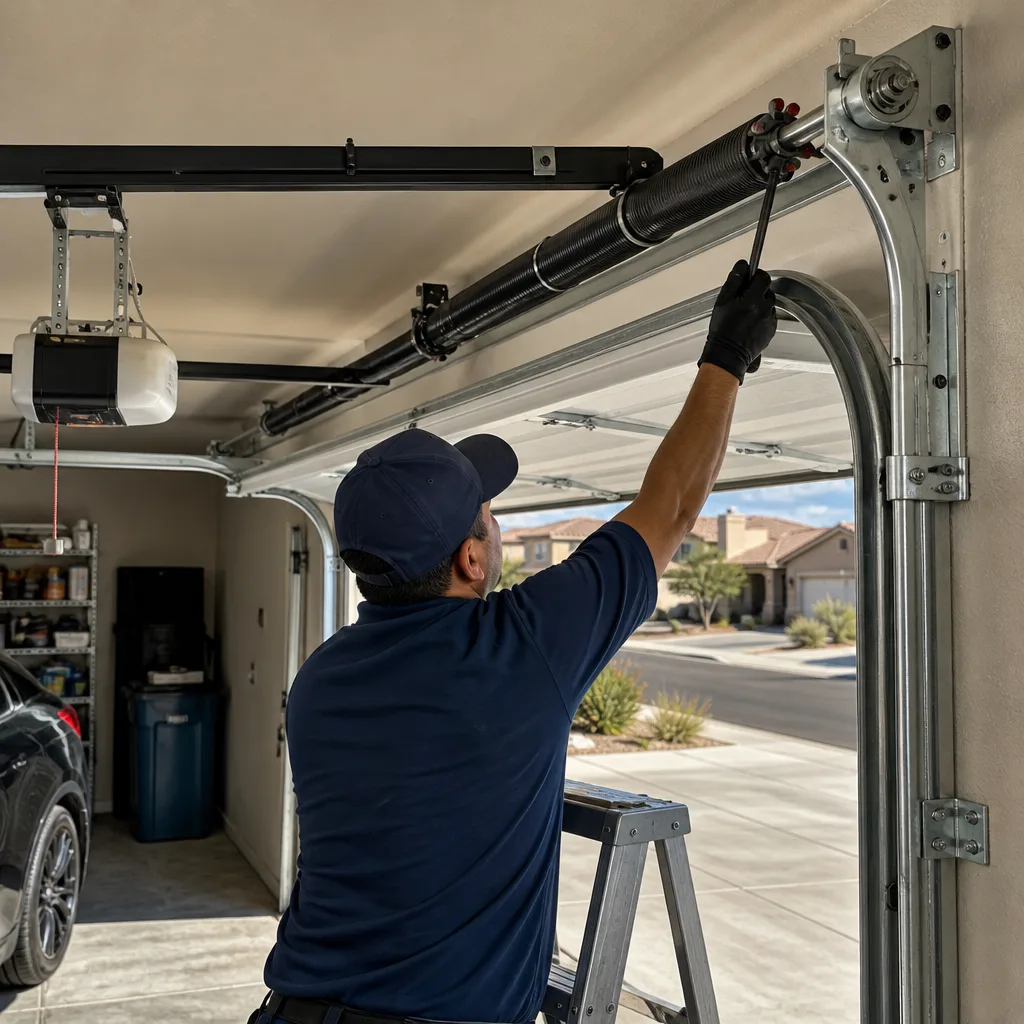 After
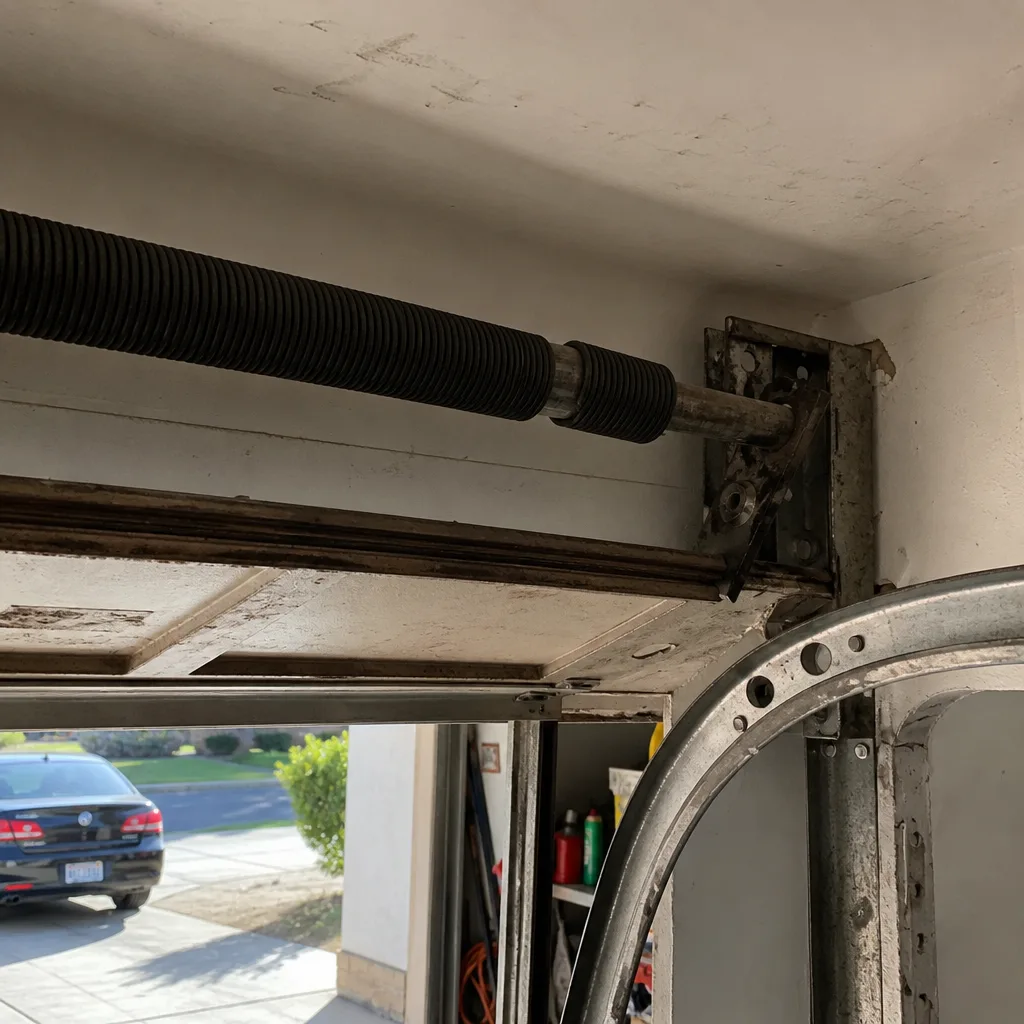 Before
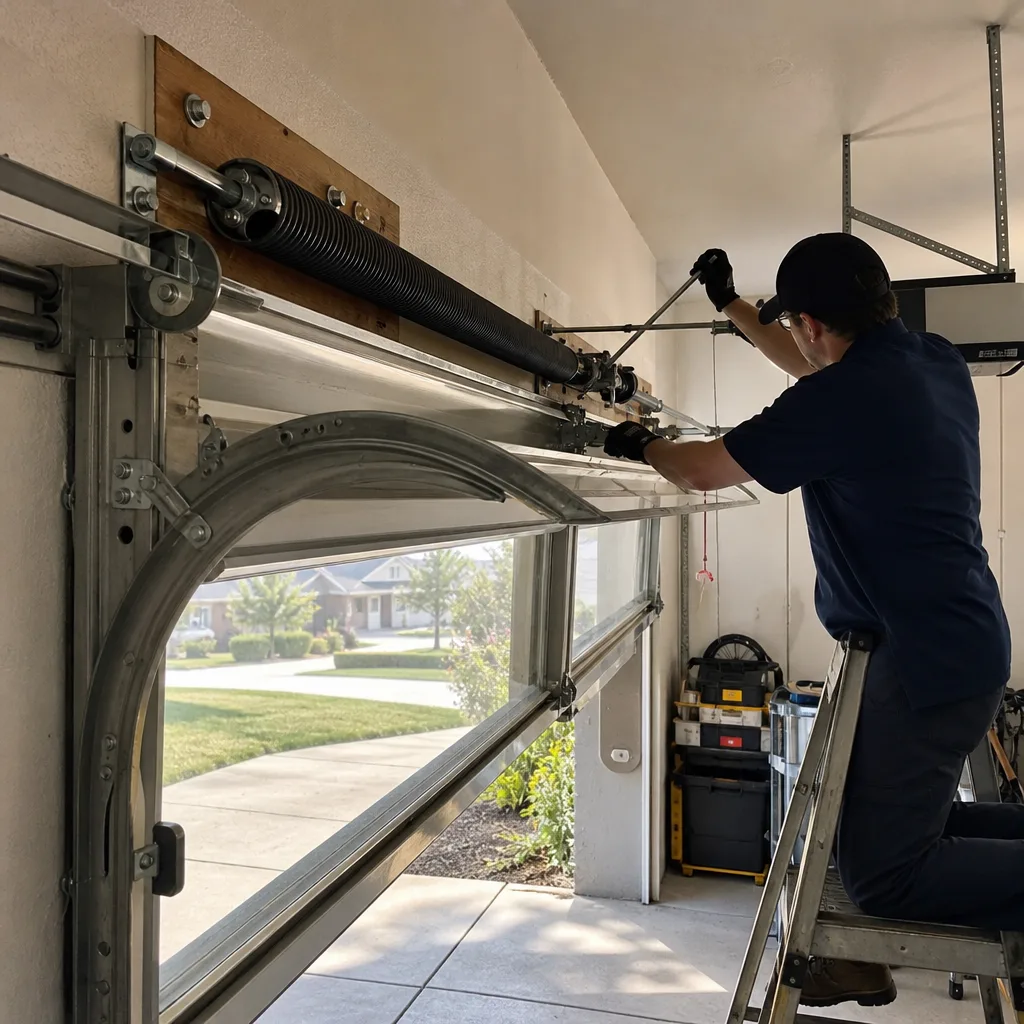 After
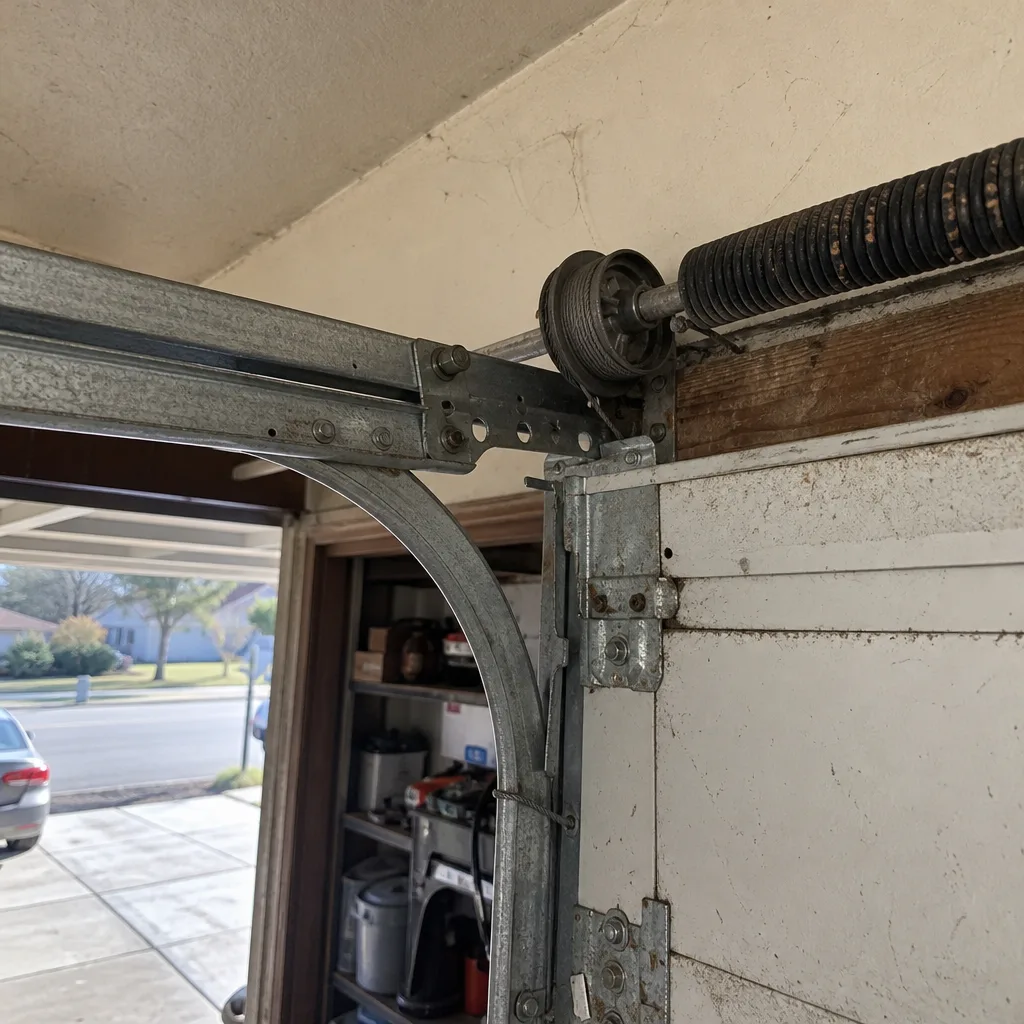 Before
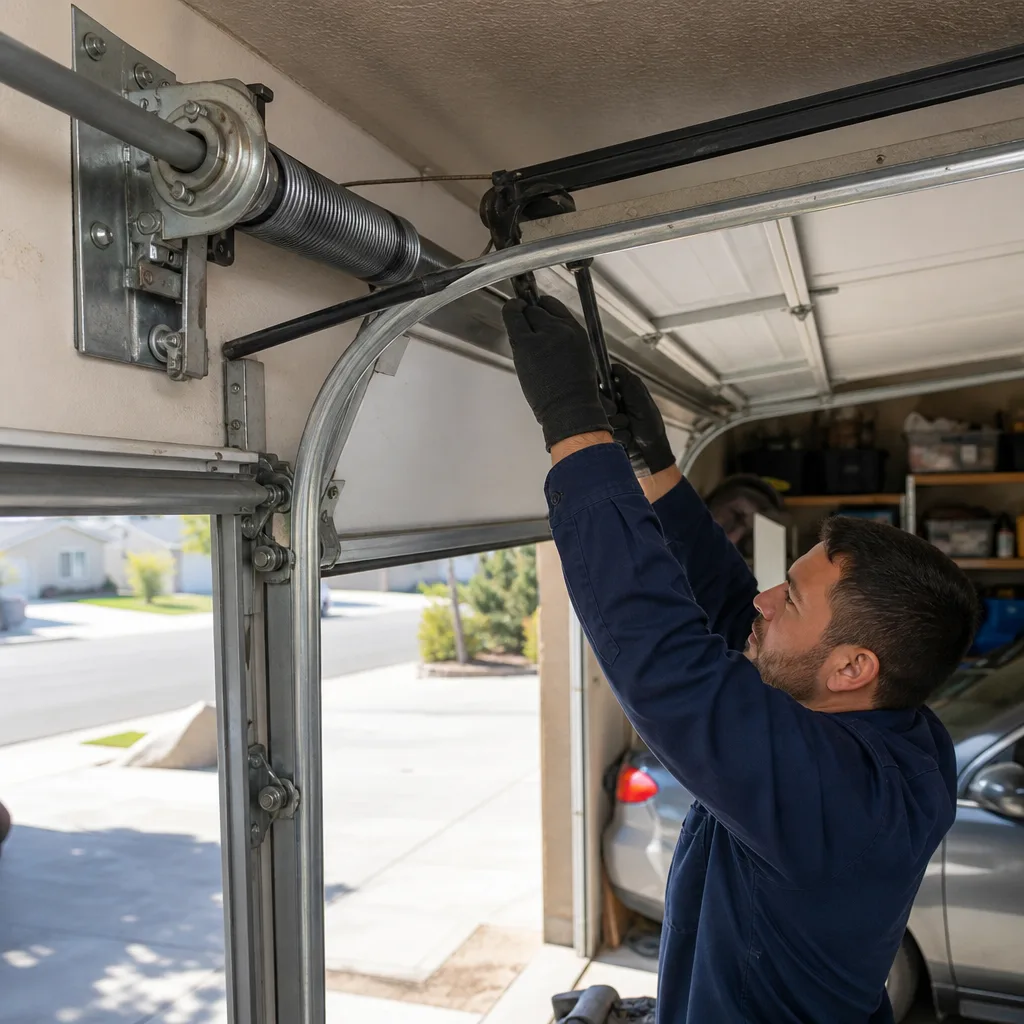 After
When to Call a Professional
You should call a professional when any of these conditions apply: the door has a broken or stretched spring, a cable is frayed or snapped, the track is bent or loose, the door is out of balance and fails the monthly test, the opener is making grinding noises or failure codes, or the door has been hit by a vehicle and the structural integrity is in question. If a spring has already snapped, do not attempt to open the door manually. The door’s full weight is no longer counterbalanced, and lifting it can cause the remaining components to fail catastrophically. In any of these scenarios, the math favors a professional call. The quote is agreed before work begins, and the job includes a safety inspection that a DIY repair never includes. Garage Door Service Menifee offers free estimates in Menifee. Call (833) 593-4019 to schedule one, or visit our Garage Door Service Menifee home page for an overview of everything we handle.
Frequently Asked Questions
A professional torsion spring replacement in Menifee typically costs $180 to $340, including the spring, labor, balance check, and safety inspection. The exact price depends on the door weight, spring cycle rating, and whether one or both springs need replacement. Call (833) 593-4019 for an exact quote. Estimates are free, and the price is agreed before any work begins.
No, and this is the one DIY task where the risk isn’t worth any savings. Torsion springs are wound under 70 to 120 pounds of torque, and the winding bars used to install them become deadly projectiles if they slip. A failed attempt causes serious hand injuries, damage to the door, and a rush professional service call that costs more than the original professional repair would have.
Safe DIY tasks include lubricating rollers and hinges with silicone spray, replacing the bottom weatherstrip, programming remotes and keypads, cleaning photo-eye sensors, and painting the door. None of these tasks touch high-tension components. The monthly balance test is also a safe and valuable DIY habit that catches spring problems early.
In Menifee’s summer heat, springs typically fail at 7,000 to 8,000 cycles, which translates to 7 to 10 years for a two-car household. The national average is closer to 10,000 cycles, but thermal stress shortens spring life in the Menifee climate. If one spring breaks, the other is near the end of its life and should be replaced at the same time.
A professional spring replacement includes removing the old springs, installing matched springs with the correct cycle rating, winding the springs to the correct torque, running a balance test, lubricating all moving components, and checking the opener’s force settings. The work usually takes 45 to 90 minutes. The price is quoted and agreed before any work starts.
It depends on the opener’s age and the failure point. A gear and sprocket replacement on a 5-year-old Chamberlain or LiftMaster unit is usually worth it at $150 to $250. A logic board failure on a 12-year-old unit often pushes the repair close to the cost of a new opener. We assess this honestly because Garage Door Opener Repair in Menifee and full installation are both services we offer, so the recommendation is based on your situation, not on which option helps us more.
The Bottom Line
The DIY vs. professional garage door question resolves to one principle: the tasks you can safely handle are the ones where failure costs you wasted time or cosmetic damage. The tasks that require a professional are the ones where failure costs you a hand, an insurance claim, or a door that crashes down on a car. Weatherstripping, lubrication, keypad programming, the balance test, painting: handle those yourself and build the knowledge that comes from regular maintenance. Springs, cables, tracks, brackets, opener internals: hire a professional, get an invoice, and keep the documentation. In Menifee, where the heat shortens component life and the dust accelerates wear, that professional invoice is also your best insurance against surprise failures. When the line is clear, the decision is easy.
Written by the team at Garage Door Service Menifee, serving Menifee since 2012.